

Why Giving Voice To Teen Lived Experiences in Adult Crime Fiction Is Important
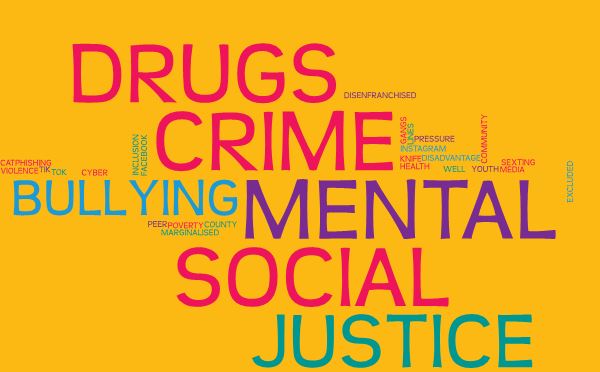
As many of us draw a line under 2021 and move into the new year with high hopes and aspirations, my thoughts turn to the families of those teens killed by another teen in the week leading up the new year, not just in London, but throughout the country and I grieve with them for the tragic, needles loss of life and of prospects. It seems to me that if, as a society, we want to minimise these occurrences, then investigating the motivations behind these acts of violence are worth exploring; What series of events led to such violence? Was there a point at which the final act could have been prevented? How can society mitigate against the circumstances leading to this sort of violence?
As an author, I address these issues through my writing and as a crime fiction author, I am concerned less with the actuality of the crime and more with the reasons and circumstances leading to it., for it is through understanding this that we can move forward as a society to mitigate against it and find solutions to these underlying issues. Which is why for my PhD research around inclusion and diversity, I chose to focus on why the adult Crime Fiction genre (the widest read genre and therefore potentially the most influential one) should be more representative of teen lived experiences.


Crime fiction is widely accepted as being the genre of social history, the genre which illuminates societal issues and gives voice to the disenfranchised, therefore it seems logical that the genre should explore marginalised teens lived experiences with a view to illuminating the issues which arise from specific circumstances. Unseen Evil explores the notion that when the circumstances of each teen’s world collide, not only with the greater dramatic world, but also with each other’s individual dramatic worlds, a chain of events can be set in motion. The key elements of the novel explore teen use/ misuse of Digital Technology, rising cases of teen mental ill health, social advantage/disadvantage and its impact on teen behaviours/motivations, the availability and effects of drugs, and an exploration of what might make teens kill.
Whilst some consider murder by young people a rare phenomenon, I view it nonetheless as a worrying indication of underlying societal issues which must be exposed, discussed and addressed. Whilst murder is the ultimate violent act, it is the circumstances and accelerating cycles of violence leading to that act that concerned me when writing Unseen Evil. The ultimate act of murder by teens is the ‘perfect storm’ scenario; it occurs when a series of elements, influences, and circumstances come together resulting in rare but devastating acts of violence. Therefore, as a pre-emptive measure, society, politicians, educators and influencers must insist that the indicators that precede and contribute to violence are addressed.
According to investigative journalist Leah Green in her documentary series Kids Who Kill (2017), 400 children have been convicted of murder in the UK in the past twenty years. Youth Justice Statistics (YJS) 2019/2020 confirm that 140 proven offences of the gravest violence against persons and sexual assaults were committed that year by children (10-17 year-olds). Heather Welfare’s 2012 study considered the effects of traumatic childhood on twenty-nine 15-17-year-old men convicted of murder between 2009-2010 as being a contributing factor in their violent behaviour. YJS (2019-2020) state that 31% of offences perpetrated by children are violence against the person with a sharp object. In that year alone 4400 proven knife offences were committed by under 17-year-olds.
In England and Wales, the age of criminality for children is between 10 and 17. These figures from the YJB (2021) record criminal activity of children between 2019 and 2020, during which period the number of children arrested was 57,600 (p.8) The Ministry of Justice (MOJ) represents the age, ethnicity and gender of the offenders in terms of the severity of the crime committed.
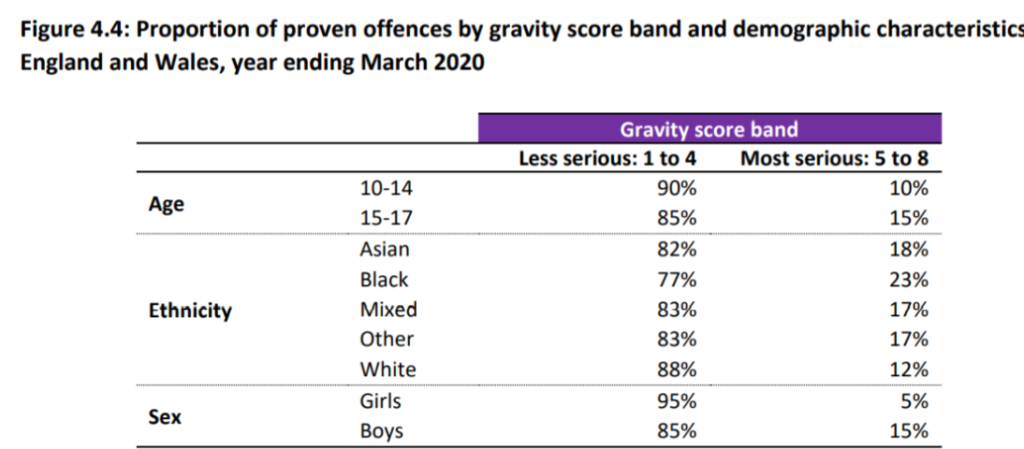
In addition, the report states that over the previous ten years, the arrests of white children fell by 80% whilst the arrests of black children fell by only 58%, and the proportion of youth arrests of black children has doubled to 12%, whilst youth arrests of children from a mixed ethnic background more than doubled from 4% to 9%. In the context of inequity of representation of BAME authors and non-white narratives, these statistics on teen criminal ethnicity raise various questions for the concerned CF author to explore: Why are black and mixed heritage children more likely to be arrested than white children? What influence do societal issues regarding race and society, equality, conscious/unconscious bias, attitudes to children of colour, social disadvantage, socio-economic status, vulnerability, and disenfranchisement have on these statistics?
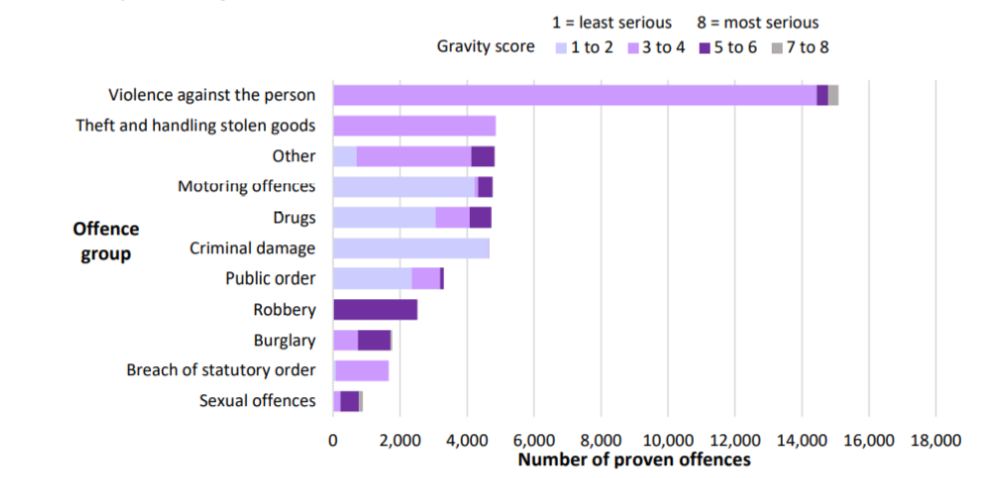
Statistics on the gender of those arrested show that whilst boys make up 51% of the general 10-17 population, they account for 85% of arrested children. Whilst these statistics are indisputable, they are limited in value as they do not take into account other demographic considerations, such as class, region, advantage/disadvantage, economic status, familial stability/instability, education and family/home life. The following MOJ chart shows the types of crimes committed by children in England and Wales:
This demonstrates that the majority of teen crime is the perpetration of violence against the person, with only a small proportion of these crimes being in the most serious categories. However, this is still of concern. Despite the marked influence of Digital Technology on the teen, there are no statistics in this report detailing the involvement of cybercrime, cyber bullying, catphishing, sexting and accessing illegal online content in the perpetration of these acts.
Here’s some reading material relating to teen crime
Allen, Rob, ‘From punishment to problem solving: A new approach to children in trouble’, US Department of Justice (2006)
Anderson, Monica, and, Jingjing Jiang, ‘Teens, Social Media & Technology’, Pew ResearchCentre (2018), Teens & Tech
Aldridge, Jo and Simon Cross, ‘Young People Today’, Journal of Children and Media, 2. 3 (2008), 203-218
Bandalli, Sue, ‘Children, responsibility and the new youth justice’ in The New Youth Justice, ed. by Barry Goldson (Lyme Regis: Russell House Publishing Ltd, 2000), pp. 81-95
Brown, Susan, Understanding Youth and Crime, 2nd edn (Buckingham: Open University Press, 1998)
Cavadino, Paul, ed., Children Who Kill (Winchester: Waterside Press, 1999)
Chalmers Phil, Inside the Mind of a Teen Killer (Nashville: Thomas Nelson, 2009)
Davies, Zoe, and Will McMahon, eds., ‘Debating Youth Justice: From Punishment to Problem Solving?’, Centre for Crime and Justice Studies (2007)
Department for International Development, Reducing poverty by tackling social exclusion: A DFID Policy Paper (London: Department for International Development, 2005)
Drummond, Rob, Researching Urban Youth Language and Identity (Basingstoke: Palgrave MacMillan, 2018)
Economic and Social Research Council Seminar Series Participants, ‘Setting the agenda: social inclusion, children and young people’, Children & Society, 18. 2 (2004), 97-105
Franklin, Bob, ‘Children’s rights and media wrongs: changing representations of children and the developing rights agenda’, in The New Handbook of Children’s Rights, ed. by Bob Franklin (London: Routledge, 2002), pp. 29-56.
James, Allison, and Chris Jenks, ‘Public Perceptions of Childhood Criminality’, The British Journal of Sociology, 47. 2 (1996), 315–31
Jensen, Amy, P., ‘Beyond Mediatized Transmissions of Youth Culture: A Study in Digital Citizenship’, Youth Theatre Journal, 22: 1 (2008), 94-107
Kárpáti, László, ‘Some Thoughts Regarding Generation Z’s Social Abilities’, Pro, Advance, Preprint, 202 (2021)
Lenhart, Amanda, and others, ‘Social Media & Mobile Internet Use among Teens and Young Adults. Millennials’, Pew internet & American life project (2010)
Margo, Julia, and others, Freedom’s Orphans: Raising Youth in a Changing World (London: Institute for Public Policy Research, 2007)
Monaghan, G, ‘Children’s human rights and youth justice’, in The RHP Companion to Youth Justice, ed. by Tim Bateman and John Pitts (Lyme Regis: Russell House Publishing, 2005), pp. 46-48
Muncie, John, Youth and Crime, 3rd edn (London: Sage, 2009)
Muncie, John, ‘Governing young people: Coherence and contradiction in contemporary youth justice’, Critical social policy, 26. 4 (2006), 770-793
Office for National Statistics, Homicide in England and Wales: year ending March 2020 (London: Office for National Statistics, 2020)
Payne, Georgina, After the panic: an investigation of the relationship between the reporting and remembering of child related crime (Loughborough: Loughborough University, 2015
Qasim, Mohammed, Young, Muslim and Criminal: Experiences, Identities and Pathways intoCrime (Bristol: Policy Press, 2018)
Ribble, Mike S. and Gerald D. Bailey, ‘Monitoring Technology Misuse & Abuse’, The Journal, 32. 1 (2004), 22-25
Rideout, Victoria J., and others, ‘Generation m 2: Media in the lives of 8-to 18-year-olds’, Henry J. Kaiser Family Foundation (2010)
Ridley, Matt, Nature Via Nurture (London: Harper Collins, 2004)
Salter, Michael, Thomas Crofts, and Murray Lee, ‘Beyond criminalisation and responsibilisation: Sexting, gender and young people’, Current Issues in Criminal Justice 24. 3 (2013), 301-316
Scraton, Phil, ed., Childhood in crisis? (London: Routledge, 2004)
Seago, Karen, ‘Translating violence in crime fiction’, Perspectives, 26. 6 (2018), 916-929
Welfare, Heather, R., and Clive, R. Hollin, ‘Childhood and Offense-Related Trauma in Young People Imprisoned in England and Wales for Murder and Other Acts of Serious Violence: A Descriptive Study’, Journal of Aggression, Maltreatment & Trauma, 24. 8 (2015), 955-969
Wiederhold, Brenda, K., ‘The tenuous relationship between Instagram and teen self-identity’, Cyberpsychology, Behavior, and Social Networking, 21. 4 (2018), 215-216
Youth Access, ‘Young, adult – and ignored. Getting a fair deal for 16-24 year olds from mental health services’, Youth Access, Policy Briefing (2017)
Youth Justice Board, Youth Justice Statistics 2019/2020 (London: Ministry of Justice England and Wales, 2021)
Youth Justice Board, Youth Justice Statistics 2018/2019 (London: Ministry of Justice England and Wales, 2020)
‘Catfish Killer, The’, When Kids Kill, Channel 5, Season 1, Ep.4, 13 July 2016
‘Child Killers, The’, Written In Blood, CBS Reality, 10 September 2017
‘Copycat Killers’, When Kids Kill, Channel 5, Season 2, Ep. 3, 21 June 2017
‘Kids Who Kill: Evil Up Close’, Channel 5, 22 December 2015
‘Date With Death’, When Kids Kill, Channel 5, Season 1, Ep.5, 20 July 2017
Facebook Killer, The, Written In Blood, CBS Reality, 24 September 2017
‘Gang Wars’, When Kids Kill, Channel 5, Season 1, Ep.4, 28 June 2016
‘Hashtag’, Criminal Minds, Season 10, Ep 7, Amazon, 12 November 2014
‘No Name Killers’, When Kids Kill, Channel 5, Season 1, Ep.6, 12 July 2016

Liz Mistry,
Scottish & Yorkshire Crime Writer
Liz Mistry moved to West Yorkshire in the late 1980s. Her gritty crime fiction police procedural novels set in Bradford embrace the city she describes as ‘Warm, Rich and Fearless’ whilst exploring the darkness that lurks beneath. Yet, her heart remains in Scotland, where childhood tales of bogey men, Bible John and grey lady ghosts fed her imagination.





© 2024, Liz Mistry. All rights reserved. Designed by Pearlnoir